



June 10, 2025
Understanding Skin Grafts
- Dermatology
- Family Medicine
- Internal Medicine
- Orthopedics

June 3, 2026 | Orthopedics
Specialties:Orthopedic Surgery • Orthopedics
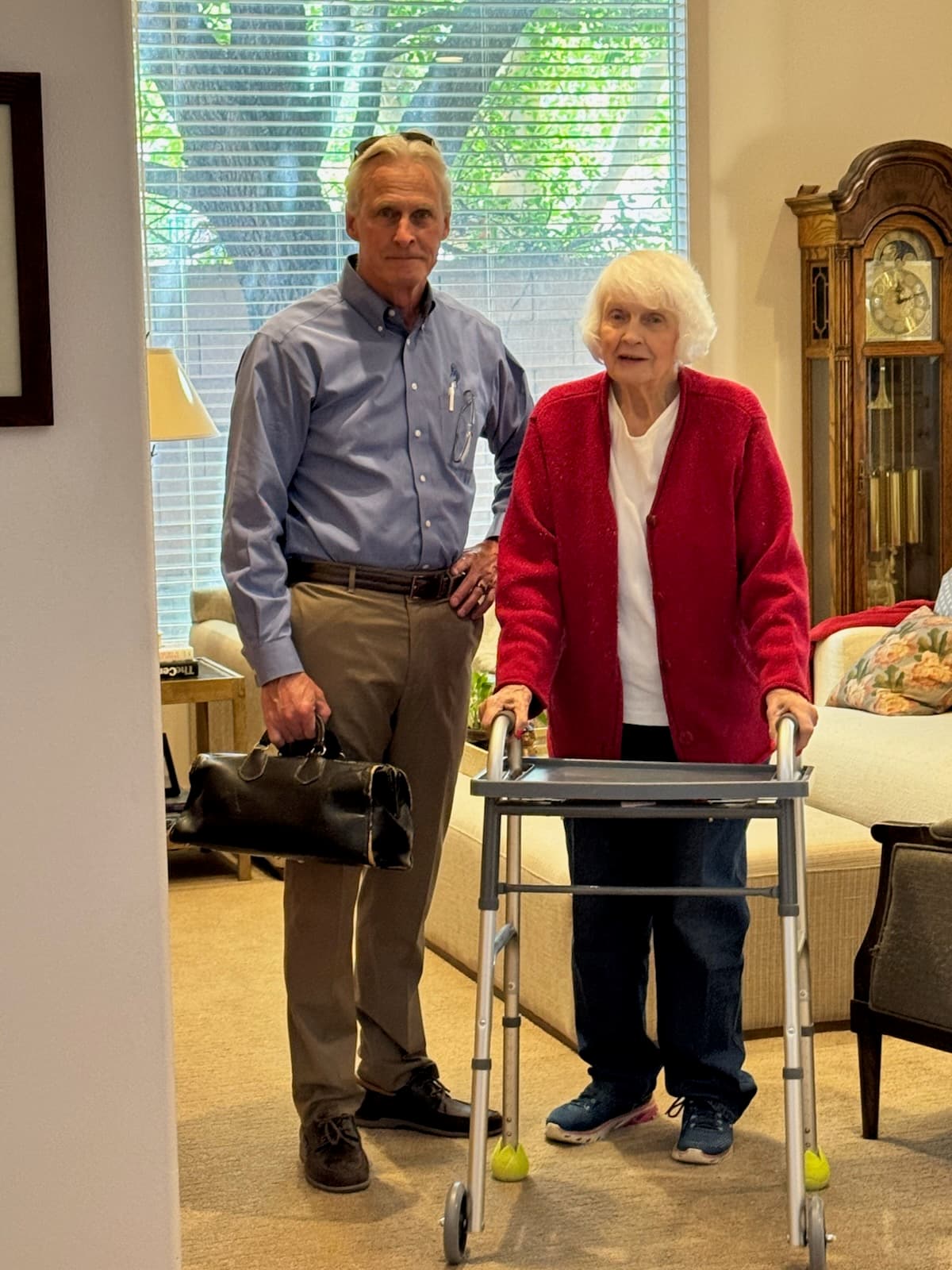
When patients see Dr. Michael Anderson arrive at their homes with his vintage black medical bag and stethoscope, they can’t help but smile. Sometimes they cry. Or, in Dr. Anderson’s words, they “melt.” They often ask for pictures and hugs as they usher him inside. In one instance, a woman excitedly told her virtual bridge group, “I have to go—my doctor is here.”
This is the power of house calls.
Though exact data is unavailable, the American Medical Association suggests that routine orthopedic house calls are rare and likely account for well under 1% of orthopedic practice encounters. However, in the growing yet still tight-knit community of Southern Utah, Dr. Anderson has found a way to revive this remnant of a bygone era. House calls have been a staple of his practice at St. George Coral Desert Orthopedics for more than 10 years.

Dr. Anderson has practiced in St. George for more than 25 years, and much has changed over the course of his career. When he first began training, patients typically stayed in the hospital for five days after a knee replacement. Now, they are “walking to their cars to head home three hours after surgery.” This shift from inpatient to outpatient care initially unsettled him.
“I got kind of nervous when people went home so quickly,” Dr. Anderson said. “I thought, ‘Who’s looking after them? How are they actually doing?”
One of the best ways to answer those questions, it turns out, is to visit patients in their homes. At first, Dr. Anderson limited house calls to close friends and family. But after seeing the overwhelmingly positive response—and growing demand—he expanded the approach across his practice. Today, he performs four to five house calls each week.
“House calls became the standard of care for virtually every total hip and total knee in my area,” he said. “If patients are happy to see you as their surgeon, that’s much better than them seeing someone in the ER who was assigned to them.”
Geography helps make the model work. Dr. Anderson can reach almost any patient within about 30 minutes. He doesn’t mind the drive because he enjoys the striking landscape of Southern Utah.
“It’s about making people feel better,” Dr. Anderson said. “And if we’re in the business of making people feel better—which ideally we are, through surgery and other treatments—then this is a perfect solution.”
House calls are about more than comfort, however. They can have tangible, even life-saving benefits.
Dr. Anderson recalls one patient who was already in poor health and recovering from surgery. His nursing team advised waiting to seek further care, but Dr. Anderson had a gut feeling. After listening to the patient’s heart and lungs and checking his oxygen saturation, he knew the situation couldn’t wait. He sent the patient to the ER, where he was admitted to the ICU for five days. The patient ultimately pulled through.
“That’s one time where a home visit saved a life,” Dr. Anderson said. “If I hadn’t been there, he wouldn’t have made it through the night, in my estimation.”
During house calls, Dr. Anderson follows a consistent set of questions, including:
He also performs standard checks, such as examining the surgical wound and observing the patient walk to assess their gait. Gait alone can reveal a great deal about recovery progress. After each visit, he shares detailed notes with his assistant to ensure appropriate follow-up.
Dr. Anderson acknowledges that house calls are not a practical reality for most physicians, but he is in a position to offer them and will continue to do so for as long as he can.
“Personalized attention is something all patients can benefit from, because everyone has different needs,” Dr. Anderson said. “Even if I can’t fix the problem, I can make people feel better. I’ve had patients tell me, ‘You coming to see me made all the difference in the world.’”
WRITTEN BY:
The Live Better Team
June 10, 2025

June 21, 2024

February 6, 2024
March 30, 2023
This information is not intended to replace the advice of a medical professional. You should always consult your doctor before making decisions about your health.